
ISTC News
UK Technical Communication Awards
Entries are now open for 2026 through the ISTC website and will close at the end of August. Please check here for details. Then fill out the entry form to nominate yourself, your team or someone else. If you need any help with your online submission, contact us at istc@istc.org.uk.
We are keeping the established guidelines. The Awards are open to any individual or team, whether employed, self-employed, contracting, volunteering, permanent, temporary, full-time, or part-time. We continue to encourage entries of all types, from traditional documentation to those demonstrating technical innovation and look forward to receiving yours.
Are we asking the right questions?
A couple of months ago, I put together a short survey asking members what type of TCUK conference they would like to have. The aim was simple, but important.
First, we wanted to engage members more directly with the organisation and with the future of TCUK. Secondly, we hoped to identify people who might be willing to volunteer and help organise the event.
The survey was shared through several channels, including LinkedIn and InfoPlus. Members were given two months to respond, and a reminder was sent one month before the deadline.
The result was striking: we did not receive a single response.
At first sight, that could feel disappointing. After all, a survey seems like a reasonable way to ask members what they want. We had done a serious amount of work to identify our main audience and understand their needs. We had tried to give members a voice. We had tried to open a door.
But perhaps the silence is telling us something important.
During a recent Council meeting, it was suggested that the issue may not have been the intention behind the survey, but the message it unintentionally communicated. Asking members what kind of conference they wanted might have been interpreted not as an invitation to participate, but as a sign of uncertainty from the organisation. Instead of saying, “Help us shape something exciting”, the survey may have sounded like, “We are not sure what TCUK should be.”
That raises a bigger question for us.
Are we asking members the wrong questions?
There is a difference between asking people to design the future from a blank page and inviting them to respond to a clear proposal. Most people are busy. Many members are lone technical communicators, freelancers, contractors, or people working in small teams. They may value TCUK, but they may not have the time, energy, or confidence to answer broad strategic questions. A question such as “What kind of conference do you want?” can sound open and democratic, but it can also feel too large, too vague, or too demanding.
People may not want to be asked to define the event. They may want to see a clear direction first, and then be invited to improve it.
That does not mean members need to be told what to want. It means that participation often works better when there is something concrete to respond to.
Instead of asking, “What should TCUK be?”, perhaps we need to say:
“This is the direction we believe TCUK should take. Does it meet your needs? What would make it more useful, more accessible, or more valuable to you?”
That is a different kind of conversation. It shows leadership, but still invites participation. It gives members a starting point. It reduces the effort required to respond. It also helps people understand what kind of answer we need from them.
Perhaps the real question is not:
“What type of TCUK conference do you want?”
Perhaps the better question is:
“TCUK is being planned as a practical, member-focused conference for technical communicators who want to learn, connect, and develop professionally. What would make it worth your time, money, and attention?”
This question is more specific. It tells members what we are trying to create. It also asks for feedback that is easier to give and more useful to act on.
We could go further and ask targeted questions such as:
- “What would make you attend TCUK this year?”
- “What would stop you from attending?”
- “What would make you recommend TCUK to a colleague?”
- “What would make you volunteer one or two hours to support the event?”
- “What kind of session would help you in your current role?”
These questions may be more effective because they start from the member’s reality. They do not ask people to imagine an entire conference. They ask about barriers, value, relevance, and practical engagement.
The lack of response to the survey does not necessarily mean that members do not care. It may mean that we have not yet found the right way to speak to them. It may mean that our questions need to be smaller, clearer, and more connected to what members experience in their working lives.
For me, the lesson is not that we should stop asking members for input. On the contrary, we need member participation more than ever. But we may need to change the way we ask.
We need to combine direction with invitation.
We need to say clearly what we are trying to build, why it matters, and how members can help shape it.
A blank page can be intimidating. A clear proposal with room for improvement is easier to engage with.
So perhaps the next step is not another broad survey. Perhaps the next step is a short, focused invitation:
“Here is our proposed direction for TCUK. Does this work for you? What would make it better? And would you be willing to help us make it happen?”
Perhaps that is the conversation we need to start: one that gives members a clearer starting point and a more focused way to contribute. If we want members to help shape TCUK27, we may need to offer them a proposal they can respond to, challenge, improve and, we hope, help us bring to life.
Advertise in InfoPlus
Get your company or products noticed in the TechComms community! We are offering new opportunities for advertising in our monthly InfoPlus newsletter.
These adverts are banners to be positioned as you choose. Placement examples are included in this PDF, which also contains all the necessary steps and costs involved to place an advert in future editions of InfoPlus.
If you would like to advertise with us please contact Chantel Sankey – istc@istc.org.uk.
Website Volunteer Team update
Content and Style
This month the website team resumed work on improving the ISTC website content. Part of the work involved stylistic improvements, using the recently revised Style Guide.
Other work involved rewriting whole pages into modern, audience-specific information, and in plain English. The team also improved their production tracker, which has made it easier to manage the editorial cycle.
These updates are examples of putting our user research into practice, and we’d love to hear what you think of the Membership pages. Send us a short email at info@istc.org.uk telling us what you like and what you think could be better!
Want to lend a hand?
If you’d like to help the ISTC improve its website and collaborate with other ISTC members in the process, send an email to istc@istc.org.uk.
We’re a friendly team and there’s no pressure to volunteer a particular number of hours – you can help out as and when your availability allows.
IJTC Update
MAY & JUNE newsletter
The latest newsletter was sent out on Sunday 21st June. It was a merger of both May & June’s newsletter and featured four articles from Jean Rollinson’s Communicator columns and two A Day In The Life articles.
Whilst browsing through the numbers, I found that there were 170 users, mostly from ASTC, who weren’t getting the newsletter due to an “oops” during their details being added to Ghost (our website tool).
After manually adding them all back onto the subscription list, the newsletter was sent to a lot more members than it was previously.
Anyone who then unsubscribes is definitely someone who doesn’t want the newsletter <insert crying emoji here>.
The IJTC website is here. Please note that to be able to log in, you must be a member of the ISTC and you will have been added when you joined.
We want your articles!
Here are the rules:
- It doesn’t have to be of an epic length. We’re not expecting you to craft x-thousand words to fill a page.
- There’s nothing stopping you from sending in multiple small articles for a series, along the lines of our series from Jean Rollinson and CJ Walker.
- It has to be relevant to the technical communicators who are part of ISTC – as well as our Australian and New Zealand colleagues.
- If you would like to submit your “day in the life”, they are also welcome.
- It must not be generated using AI. You can, however, write about AI tools used within the tech comms field.
Take a look at the other articles already on the website and see if your subject would fit in.
When you’re ready to get your article(s) published, send it to editor@ijtc.net.

ISTC Slack
The details of where to find our Slack channel can be found on the Members’ Portal page when you log onto the ISTC Website.
Note: Slack are withdrawing support for Windows 10 users of their app.
Before joining please remember:
This is a professional space, and all areas, including any private messages, may be reviewed by the ISTC and are subject to the ISTC’s Code of Professional Practice.
We look forward to seeing you in there.
Area groups
If you wish to start your own Area Group, contact istc@istc.org.uk.
Thames Valley Area Group
The Thames Valley local group meeting is at the Bird-in-Hand pub in Knowle Hill, RG10 9UP on the first Tuesday of each month from 7.30pm. All are welcome.
There’s rarely a set subject but the conversation always has a strong tech comms flavour. Maybe something from recent news, something that has happened at work, or some new technology to discuss.
London Area group
The next London Area Group meetup is planned for Wednesday 22nd July. We are finally back to doing face-to-face meetings and we will be meeting at the usual place on the South Bank.
The meeting invite will be posted in the WhatsApp chat for the group nearer the time.
ISTC Meets
This is our monthly series of online live presentations and discussions from industry experts across the Technical Communication spectrum.
For full details of all of our previous speakers, and for all future ISTC Meets, please visit our website.
no ISTC Meets in July & August
Our ISTC Meets take the summer months off and we will be back in September with more talks for our members.
Contact the ISTC directly, istc@istc.org.uk, to be added to the ISTC Meets mailing list.
Talking heads wanted!
Do you want to give a 30 minute talk on any aspects of tech comms (via Zoom)? Get in touch with ISTC Meets.
Social Media
We recently pared back our social media areas to make them easier to manage and post to. Our FB pages for ISTC and TCUK will remain for the time being whilst they are archived, then they will be removed permanently.
Community Forums
The forums are available to all members once logged into the ISTC website.
AI News & Apps
AI doing good things
AI helped diagnose 18 children whose rare diseases had stumped doctors.
Researchers from Boston Children’s Hospital identified 18 diagnoses for children with rare diseases using OpenAI’s o3 model.
The headline has the link to the article on NBC News, or if you want the full-on-detailed view, here’s the original article from the OpenAI site.
Microsoft dumping Co-Pilot?
Microsoft apparently has eyes for other AI models – particularly ones that are cheap. According to a report from Axios, token maxxing is taking its toll on Microsoft’s AI tool Copilot, and it is looking at the possibility of using its own version of the Chinese open-source model DeepSeek to keep its costs down.
NOrway bans aI from young children
After banning smartphones and tablets classrooms, Norway has imposed broad restrictions on AI for elementary school kids.
This will be from late August 2026, Norwegian school children (aged 6 to 13) will have no access to generative AI tools as a general rule.
meta stops tracking workers
Meta halts worker tracking program for AI training due to privacy fears.
The program started only two months ago by Meta to gather data on how people used computers, including mouse clicks and keystrokes, that could be used to train artificial intelligence (AI) models.
The cynical would just say “because they were caught doing it” …
New Tools
A round-up of some new AI tools that might be of use to all tech comms people.
Note: Just because I’ve included a particular AI app in the selection below, it doesn’t mean that ISTC are promoting these AI apps.
I do recommend, however, subscribing to the There’s An AI For That‘s newsletter if you want to keep yourself up to date on all things AI.
EXA Agent
Exa Agent: a single API to access frontier web research capabilities at a fraction of the cost.
Exa Agent combines top language models with Exa’s state-of-the-art web search tools to achieve the most exhaustive and accurate results now used in a variety of agentic products.
palmier
Palmier is a Mac-only AI video editor to run locally on your machine. It allows you to generate, edit, and export production-ready AI videos without leaving your timeline.
EZFigure
EZFigure is an AI-driven tool designed to facilitate the creation of professional scientific figures, diagrams, plots, and visual content.
It is tailored for scientific presentations, academic papers, and instructional materials, the EZFigure AI agents manage the process of planning, generating, reviewing, and refining these figures.
Free AI courses (care of Gov.uk) at AI Skills HUB
Technical Writer HQ Infographic
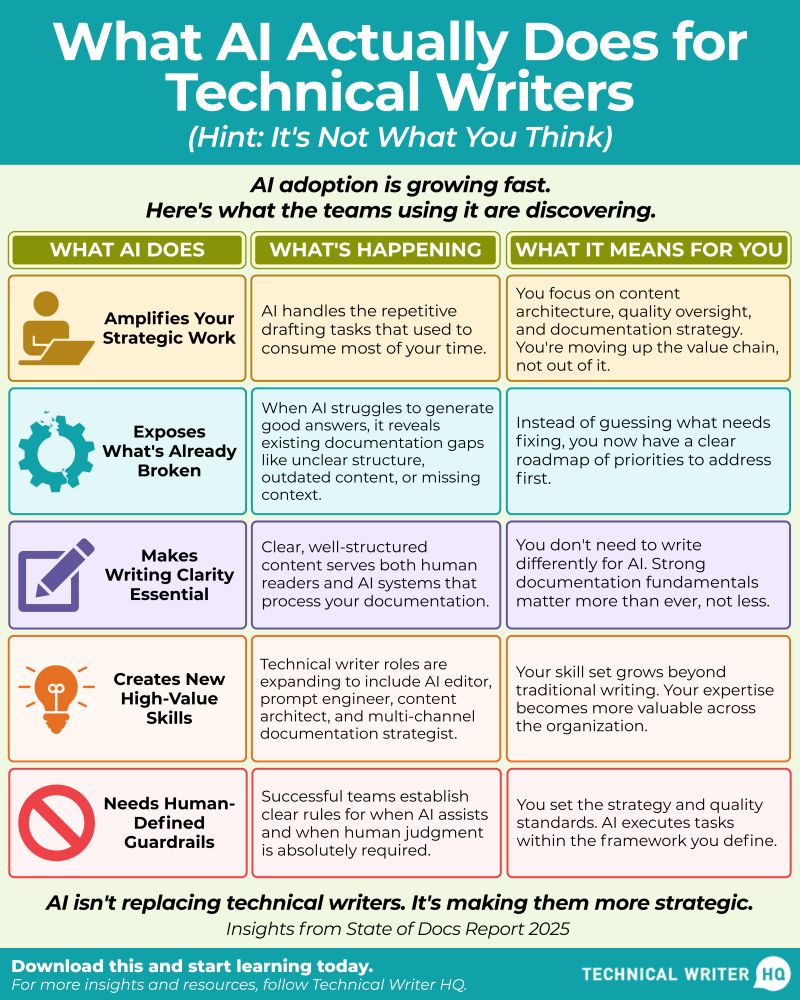
Our thanks go to Technical Writer HQ for the above infographic. We will be including one in every issue of InfoPlus for the remainder of this year.
Upcoming Events
There are multiple in-person and/or online-only conferences coming up this year. If you think we’ve missed any out, please get in touch via newsletter.editor@istc.org.uk, or send me a message via the ISTC Slack channel.
There’s a lot less conferences happening during the summer months, so the list has shrunk a bit after all the June ones were removed.
Title: UX Camp, Amsterdam
Date: July 4th 2026
In-Person: HvA Corry Tendeloohuis (CTH), Amsterdam
Website: https://uxcampams.com/how-it-works
UX Camp Amsterdam is back for its 9th edition – a community-run unconference where you set the agenda, run the sessions, and shape the day.
No keynotes. No panels. No passive sitting. Everyone contributes.
Title: Write the Docs, Berlin
Date: September 6th – 8th, 2026
Online/In-Person: Both – Paul-Lincke-Ufer 21, 10999 Berlin
Website: https://www.writethedocs.org/conf/berlin/2026/
Write the Docs is a global community of people who care about documentation: Programmers, Tech Writers, Customer Support, Designers, Project Managers, Developer Advocates, and anyone else who wants people to have a great experience with software.
Created in 2013 in Portland, Oregon, WTD has hosted conferences around the world in Prague, Sydney, Amsterdam, London, and Melbourne.
We invite you to our Berlin conference to join 200 other attendees to explore the art and science of documentation!
Title: Lead with Tempo 2026
Date: September 10th
Online/In-Person: In-Person at Barbican Centre, London. EC2Y 8DS
Website: https://www.leadwithtempo.com/
Our global leaders cover topics such as:
- Thinking beyond the product to connect content across our orgs
- Leveraging AI within your teams
- Setting content design teams up for success
- Best-practice when designing for AI
- Fostering design-wide advocacy for content
Title: Lavacon 2026
Date: October 25th – 28th, 2026
Online/In-Person: Charlotte, North Carolina, USA
Website: https://www.lavacon.org/
LavaCon is a gathering place for Content Strategists, Documentation Managers, and other content professionals willing to share their best practices and lesson learned – what worked, and what didn’t.Our Mission: To help organizations reduce costs, increase revenue, and improve the Customer Experience through better content.

Accredited courses have been reviewed by a professional panel of experienced ISTC members. A course listed as “ISTC Accredited” means that the panel believes the course meets its stated objectives and is suitable for its intended audience.
Course providers have to apply for renewal of accreditation every 2 years, which helps to ensure the courses reflect current best practice.
Training courses
Armada
The Technical Authoring Training Programme by Armada is run over 5 days.
You can attend in-person at our dedicated training facilities at Bristol, Bromsgrove, Manchester or Reading, or participate live online.
The next course dates are:
- Online – 14th-18th September 2026
- Bristol: Classroom-based – 14th-18th September, 2026
- Reading: Classroom-based – 23rd–27th November, 2026
For further details, see www.armada.co.uk/course/tatp.
Cherryleaf
The Cherryleaf courses are available online and can be booked for single tech comms people or as a group.
Using Generative AI in Technical Writing: https://cherryleaf.teachable.com/p/using-generative-ai
Technical Writer – Induction Course: https://cherryleaf.teachable.com/p/technical-writer-induction-course
TCTrainNet – tekom Certificate training in Technical Communication
There are two accredited courses available from TCTrainNet:
- TCTrainNet Professional
- Aimed at beginners and career changers. Intakes are from 21st September, 2026, with additional slots on 23rd November 2026.
- Aimed at beginners and career changers. Intakes are from 21st September, 2026, with additional slots on 23rd November 2026.
- TCTrainNet Expert
- Aimed at experienced technical writers. Intakes are from 12th October 2026.
Firehead
Firehead offer a number of accredited courses. They are supplied in a format of videos, PDFs, eBooks and assessments.
- DITA Concepts
- Make Search Better: An Introduction to Keywording
- Structuring Prompts for Technical Communicators and Content Developers
- Presenting in English with Equal Impact
- Content Strategy Overview
IMPORTANT
Attending an ISTC Accredited course does not automatically make you an ISTC Member. Becoming an ISTC member is separate from attending an accredited course and requires applying separately. If the training course has wet your whistle, then come and join us.
About InfoPlus
InfoPlus is your go-to source for staying informed about our profession, featuring news not only from the ISTC but also from across the technical communication community.
This complimentary newsletter is emailed to approximately 1500 individuals.
Subscribe to InfoPlus by clicking here, you can unsubscribe at any time from within the email sent out each month.
For advertising enquiries, contact istc@istc.org.uk.
Submitting content
If you have noteworthy information to share with your peers, please send it my way at newsletter.editor@istc.org.uk. We want to ensure that your news reaches as many people as possible.
About our publishers
InfoPlus, the Monthly Newsletter from the Institute of Scientific and Technical Communicators (ISTC), is a valuable resource for the largest UK body representing scientific and technical communicators.
Whether you are involved in technical writing, technical illustration, or other forms of communicating technical information, ISTC is the professional association dedicated to supporting your career.
Published and distributed on the first working day of each month, InfoPlus occasionally experiences slight delays until the first week of the month. Keep this in mind when submitting time-sensitive information.
Explore the benefits of ISTC membership and find out how to join.
Back Page
I will freely admit that I’ve been around the block a few years, but I’ve rarely changed my word processor favourite from Word to anything else.
I can blame that on my HND in Computing lecturers trying to force us to use WordStar (for DOS) in our first month.
WordStar for DOS suffered from a cluttered, non-intuitive interface, poor handling of modern printers, and a failure to adapt to the graphical shift in the 1990s.
That, along with a reliance on key combinations, some were longer than spells in a grimoire, helped to kill it off by the end of the 1990s.
It wasn’t long before one of my college mates found where Word for DOS 5.5 (with mouse support!) was being hidden on the network, and I’ve used Word ever since then.
However, before I get lynched by the pro-WordStar fans, I also found this video on You Tube which explains why some authors are still using WordStar today, including the creator of The Game of Thrones.
Why Do Best-Selling Writers Use a 40 year-old Word Processor? – YouTube
Can you do any better?
If so, you can send them to newsletter.editor@istc.org.uk, or send me a message via the ISTC Slack channel, by 20th July 2026.