
Building on TechSmith research, Matthew Pierce discusses: when videos are viewed, the length of videos and keeping viewers interested.
Let’s be honest, when you think of what a technical communicator does the first thing that comes to mind is probably not video communication – and yet video is increasingly becoming a large piece of their workload. Whilst it is still not so common to technical communicators that they need to work with video daily, it is beginning to have more of an impact on their daily lives and technical communicators will now need to be ready to create videos for their work.
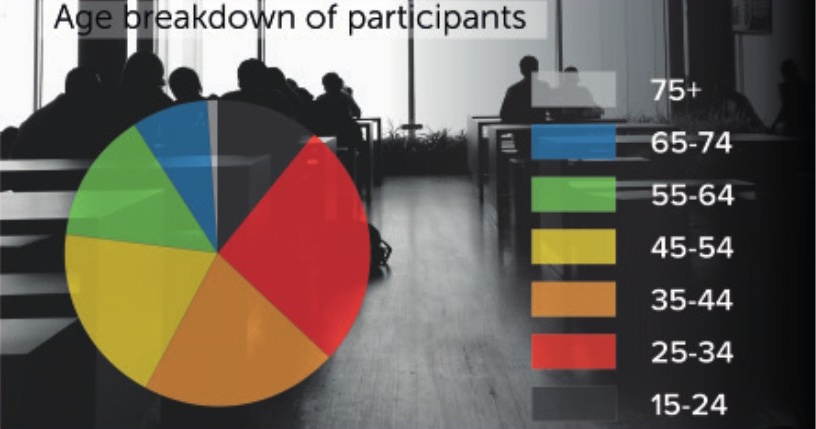
Since video is growing in usage for technical communicators, TechSmith Corporation, wanted to better understand what makes a great video. As a field and profession, if we can determine the attributes that make a video great, perhaps we can reverse engineer those pieces and apply them to our own videos. TechSmith’s Viewer Research Study comprised 1900 participants from a variety of roles and industries including financial services, education, government, healthcare, manufacturing, software design and development, and more. The majority of participants fell within the age range of 25 to 64. (See Figure 1 below.)
Since there are different purposes for videos, questions were asked to help determine what type of video they were thinking of during the research. The types of video were narrowed down to three: Entertainment, Informational, and Instructional. For our purpose, we focused our research on learning from those who were considering informational and instructional video.
Let the Experiments Begin
Among the key learning of the research, there are lessons that everyone who is considering creating a video should consider, which when applied will help guide us to creating better and more effective visual content. Like all research, I invite you to run your own experiments and validate the research in your environment and for your particular audience.
Video Viewership
With the rise of YouTube and other video sharing sites, the amount of video being consumed on the web is increasing. According to a report from Cisco1, online video users are expected to double to 1.5 billion in 2016. While a lot of video viewership will be focused on entertainment and its increasing ubiquity, not all of it will be, some portion will be focused on information delivery and instruction. As video viewing increases, there are points you should understand about how to create better videos, which will allow for better engagement and enable you to achieve your end goals.
Some of the results of the study give insight into viewer habits, which may not help you craft your content, but may help you make sure you shape the experience. For instance, instructional and information videos are watched most in the morning and the evening. This could indicate that viewers are watching when they feel they have time. This leads to asking, what does the information delivery need that will allow the viewer to get the most from the information?
Importance of video length
For a number of years, I have taught people that videos need to be short, concise, and probably no more than three minutes in length. I have found that whilst this is still the case, it didn’t take into consideration what viewers wanted.
The data from the research indicates that for instructional and informational videos a higher percentage of viewers actually prefer longer videos, with the range varying between four to fifteen minutes in length. When looking at those that were flagged as good or great videos, the length of instructional and informational videos can sometimes be up to 10 minutes in length.
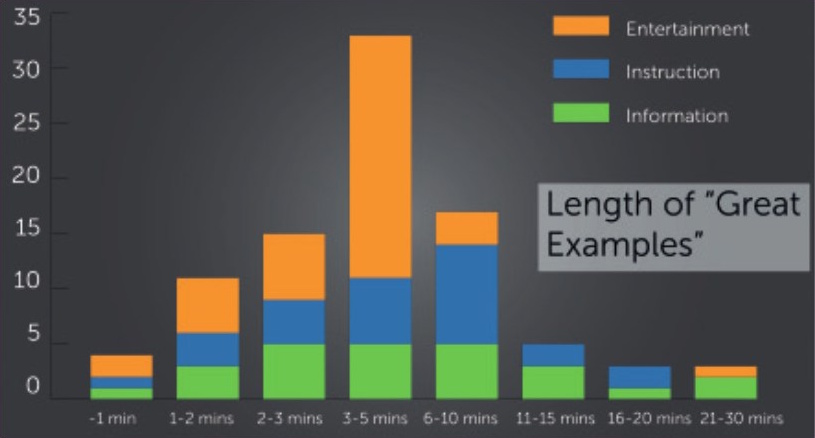
The length of the video may seem surprising but with more context, it is understandable why a viewer would prefer a longer video. Think about the information you might want to deliver or something you would want to teach; it can be often difficult to condense that information down to a one to three minute video.
In addition, other data points indicate that viewers want the right information that will guide and direct them. If the video has too little or too much, they aren’t going to want to view it.
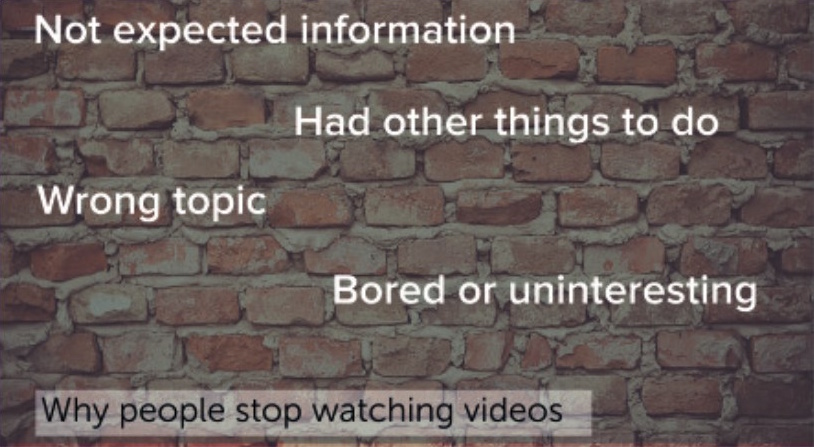
This is a difficult balance to achieve, but is solvable by asking appropriate questions to understand what problem needs to be solved and what information or instruction will help to provide the solution. In fact, a number of survey participants indicated that they stopped watching a video because it was: not the expected information, the wrong topic, boring or uninteresting content.
As you start creating videos, remember you have flexibility in the length, but if you provide too much information that is not directly helpful or relevant, the video will be less effective.
Keeping viewers interested
One of the prime reasons that viewers turn off to video is because the delivery of content doesn’t engage or appears as boring. The TechSmith Viewer study dug into what makes content uninteresting. There are many ways to be considered boring, just a few of them include:
- A dull or monotonous speaker
- Content is by nature boring
- The pace of delivery is too slow
- The information is a repeat from earlier delivery of material
- A bad approach has been decided and taken.
Overcoming some of these hurdles can be challenging. Audiences can be subjective and depending on your audience size, you may need to determine what is the least problematic approach, without letting the video become too generalised or plain – which will also cause viewers to stop watching.
What is the best information to present?
Some participants in the study indicated that they actually wanted different information from what was provided in the videos they had seen. This can be subjective as we can’t always deliver what they want versus what they need, but we should keep in mind that viewers, especially learners do tend to have a good gauge of whether the information achieved its objectives.
When viewers wanted different information, we found that what they were missing is details. If the content was instructional in nature, they found there wasn’t enough step-by-step instruction. Also, on many occasions the content of the video was not accurately reflected in the description, which can lead the viewer down the frustrating path of starting a video only to discover that it doesn’t meet their needs.
Finally, viewers indicated that instructional and informational videos were not specific enough. It’s easy as a content creator to assume how much any one of your viewers may already know. And since it can be difficult to pre-assess knowledge and deliver just that needed , testing and being open to feedback from your audience is critical to success.
Conclusion
As we move into a digital era where video content is becoming king, technical communicators need to find a fine balance between creating videos that achieve their purpose and understanding how their viewers will best consume their content. One cannot exist without the other.
The best video will be created by a person who has considered the content, how it is delivered, the amount of detail, and even the amount of time to ensure it does not fall flat with viewers. In comparison to entertaining videos, instructional and informational videos need to work that little bit harder to win over audiences, but through a variety of settings and interesting approaches viewers can stick to your content like glue.

Matthew Pierce is an instructional designer, video producer, visual communicator and storyteller.
He has created video tutorials for TechSmith Corporation, and has facilitated sessions on using visuals to communicate. He also hosts a web show that focuses on visual communication.
E: m.pierce@techsmith.com
W: www.techsmith.com
B: blogs.techsmith.com
Tw: @piercemr